29/05/14: Setting the Standards for Salmon Vaccination

Robert Wittmann visiting International
Aquafeeds booth at Aquaculture UK
Aqualife and the University of Stirling's Institute of Aquaculture are organising a mini-conference on salmon vaccination on June 11, 2014 in Stirling, Scotland.

With just two weeks notice the organisers have informed IAF that its the first time for several years that the vaccination sector in aquaculture is coming together to discuss standards and a way forward for a more co-ordinaries approach for salmon.
 
Robert Wittmann, operations manager at Aqualife says companies leading in the field, such as Pharmaq, MSD, Salmon Vaccine, Marine Harvest and Novartis, to name a few, have registered their interest in participating.
 
"There is no standard for vaccination procedures, but getting it wrong can have major negative consequences for fish welfare and the quality of the end product," say Mr Wittmann.
 
Speakers representing the main producers of salmon vaccines, farming companies, fish health professionals and vaccination companies will lead the discussion on the issue of Salmon Vaccination - Setting the Standards.
 
Please email info@aqualifeservices.co.uk or speak directly to Sally on +44 1786849141 to register.
The Aquaculturists
This blog is maintained by The Aquaculturists staff and is supported by the magazine International Aquafeed which is published by Perendale Publishers Ltd.

29/05/14: Aquaculture UK 2014 - 'Biomass Control'


International Aquafeed attended a talk given by Herman Kristjansson, Managing Director of Vaki, as  part of the opportunities and Challenges for Scottish Aquaculture conference on day two of Aquaculture UK 2014. 

Kristjansson’s talk titled Biomass Control – a major challenge forward, identified Biomass control as a key challenge for Scottish fish farmers.  Vaki’s new frame Biomass Daily (which is placed inside cages) allows companies to monitor fish accurately on a daily basis providing measurements of exact weight and numbers. Kristjannson believes this technology should be used all the way from hatching to harvest as a way of overcoming the difficulties.
The Aquaculturists
This blog is maintained by The Aquaculturists staff and is supported by the magazine International Aquafeed which is published by Perendale Publishers Ltd.

29/05/14: Steen-Hansen - Book on Fouling to be launched in the UK

http://www.steen-hansen.no/#/ 

www.bookonfouling.com
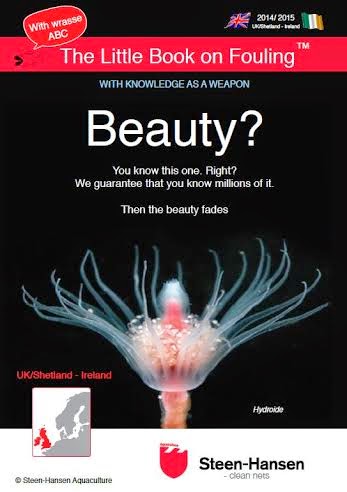
After a successful year in the Norwegian market (more than 7000 copies distributed), a UK version of Den lille Groeboken is now launched at Aquaculture UK, Aviemore: The little Book on Fouling (UK/ Shetland – Ireland)

The 60-page, high-quality booklet (A5) is distributed free of charge – and is objective and non-commercial.

Book on Fouling covers key aspects related to fouling as an increasing problem in modern aquaculture: Species and species recognition – conditions fueling fouling – invading species – geographical distribution of the various species (and potential distribution) – wrasse ABC and much more.

The booklet can be found here as a free resource: www.bookonfouling.com

Book on Fouling is a result of cooperation between Steen-Hansen Aquaculture and various research institutions in the UK and in Norway.

 The Aquaculturists
This blog is maintained by The Aquaculturists staff and is supported by the magazine International Aquafeed which is published by Perendale Publishers Ltd.

29/05/14: FAIVRE


An Innovating Manufacturer

In the 1950's Claude FAIVRE was originally a miller who then became a fish farmer. He missed the mechanization associated with milling, so he decided to build machines that would make the work of fish farmers less difficult. So he created the first automatic calibrator for trout known as "The Calibromatic". Continuing to be inspired by the mill he adopted the idea of using pipes to transport fish, So, the foundations of fish farming mechanization were built - starting its story in 1958 it continues to this day.


FAIVRE boasts an international presence in more then five continents and thirty countries, using its next generation factory to cut, weld and fold steel with laser precision. Working in collaboration with its 3D engineering design department it is able to provide its customers with the best customizations and quotes possible

Learn More About FAIVRE here

The Aquaculturists
This blog is maintained by The Aquaculturists staff and is supported by the magazine International Aquafeed which is published by Perendale Publishers Ltd.
Aquaculture UK 2014 see Novartis award presented at gala dinner

Today International Aquafeed attended a series of six conference at Aquaculture UK 2014, hosted by Novartis, featuring talks by PhD and Masters students from Scottish universities. 

Their research touched upon important aquacultural topics and all were competing for the chance to visit Prince Edward Island, Canada, the home of Novartis' fish vaccination centre.

And IAF can announce the winner of the Aquaculture UK 2014 Gala Dinner and prize giving ceremony which has just come to an end! By coincidence it was the presenter we had listened to and decided was the most appropriate for us to report on here. 

The winner is Ms Marie Smedley and we present here a brief synopsis of her presentation which was a particular highlight for us.

Entitled 'Nutrition as a tool to improve performance in Triploid Atlantic salmon (salmo salar) in freshwater and seawater production' - by Marie Smedley, Institute of Aquaculture, University of Stirling.

Marie is completing a PhD study into Atlantic salmon Triploids. Sponsoring this study were Biomar and Marine Harvest Scotland. 

Triploids are sterile fish which have three chromosomes in their genetic make up and can be seen as sustainable to farm commercially. The fish are still not perfect because they display reduced tolerance to sub-optimal environments, she told her audience. 

However, she understands that it is not a sustainable solution in terms of cost to farm on a larger scale.

Marie believes that Triploids and phosphorus to be a winning combination; she explained to us that their phosphorous requirement must be met from the diet and cannot be met by freshwater or seawater environments. 

Bactocell - a product from Lallemand - was also used and had a positive effect on mitigating malformation development of vertebrae and jaw growth and was used after phosphorus.

Triploids in the study grew faster in general as opposed to the diploid salmon. The growth was marked after the first four months, then it was 20-30 percent faster in freshwater and 10 percent faster in seawater, compared to normal diploid fish and normal conditions

Tomorrow is the final day of Aquaculture UK 2014 at the MacDonald Resort in Aviemore. It's been an eventful day in this beautiful part of Scotland!
 

 The Aquaculturists
This blog is maintained by The Aquaculturists staff and is supported by the magazine International Aquafeed which is published by Perendale Publishers Ltd.

Aquaculture UK

Come along and meet the team behind The Aquaculturists and International Aquafeed magazine today at Aquaculture UK 2014 in Aviemore, Scotland . Find us at stand 81

Aquaculture UK - what is happening right now!

23/05/14: SalMar - Results for the first quarter 2014

SalMar achieved its strongest ever operational EBIT in the first quarter 2014 as a result of record high salmon prices. Although biological challenges once again had an impact on earnings during the period, the company's ongoing programmes are now bearing fruit and are leading to a steady improvement in underlying operational performance. SalMar made an operational EBIT of NOK 485 million during the period, a rise of NOK 137 million from the previous quarter and a substantial NOK 250 million more than in the corresponding period last year.
 
The result is due to high salmon prices, but we are also seeing indications of improved operating performance and reductions in underlying costs from some of our farming segments," says SalMar's CEO Leif Inge Nordhammer. "At the same time, the biological situation remains challenging. The growing intensity of salmon lice infestation and increasing resistance to treatment that we see ahead could affect fish growth rates and harvesting plans in coming quarters, with attendant consequences for costs."

The average price of salmon was 32 per cent higher in the first quarter 2014 than in the same quarter last year. SalMar's gross operating revenues rose to NOK 1.6 billion, up around NOK 350 million from the first quarter 2013. In total the Group harvested some 27,800 tonnes of salmon during the period (23,200 tonnes). As a result, operational EBIT per kg in the quarter came to NOK 17.45 (NOK 10.14).

All the fish farming segments posted satisfactory results, although regional differences remain considerable. Operations at SalMar Central Norway and the Rauma segment were affected by biological and logistical challenges, with EBIT per kg closing the quarter at NOK 19.35 and NOK 15.68 respectively. SalMar Northern Norway, on the other hand, posted a record EBIT per kg of NOK 21.05.

The Sales and Processing segment is now able to keep PD-infected fish in holding pens prior to harvesting, which has improved production efficiency. However, lower than normal harvesting volumes reduced capacity utilisation. The segment's results were also negatively affected by the Group's fixed-price contracts, which accounted for 35 per cent of the total harvested volume during the period. From sales revenues of just under NOK 1.4 billion in the period, the segment made an operating loss of NOK 28 million. Contracts are expected to account for approx. 40 per cent of volume in the coming quarter.

The current average weight of the fish transferred to the sea in the spring of 2013 is lower than the corresponding 2012 generation had at the same point last year. Although this will have an impact on the volume harvested in the coming quarter, the overall level is still expected to be slightly higher than in the first quarter.
Based on the estimated standing biomass at the close of the period, the global output of Atlantic salmon is forecast to grow by around 7 per cent in 2014 as a whole. SalMar is experiencing strong demand in all the company's core markets, and expects the salmon market to remain strong for the rest of the year.

SalMar is keeping its harvesting forecast unchanged, and still expects to harvest 133,000 tonnes in Norway in 2014. Norskott Havbruk (Scottish Seafarms) expects to produce a total of 25,000 tonnes in 2014, with SalMar's 50 per cent share coming to 12,500 tonnes. 

The Aquaculturists
This blog is maintained by The Aquaculturists staff and is supported by the magazine International Aquafeed which is published by Perendale Publishers Ltd.

23/05/14: Panabo City conducts Tilapia hatchery seminar


Pursuant to s35 of the Aquaculture Act 2001, Applications are invited from suitably qualified individuals/companies to undertake farming of aquatic animals in a manner that involves regular feeding and or the farming of algae within the waters of the Boston Bay aquaculture zone (excluding Bickers Isles sector) located within the Aquaculture (Zones — Lower Eyre Peninsula) Policy 2013. A total of 16 hectares will be made available.
The Aquaculture Tenure Allocation Board (ATAB) will consider all applications received and provide advice on the allocation of the released hectares. The assessment process will take into consideration the applicable criteria and the assessment guidelines which are included in the attached Invitation to Apply document.  This document also includes a lease application form.
Completed applications with attachments and fee must be submitted on the prescribed form and address the applicable criteria. The application must be received by PIRSA Fisheries and Aquaculture by 5pm Friday 20th June 2014. Application forms and further information can be obtained from Mrs Emily Mellor, Senior Adviser, Aquaculture Policy, Planning and Environment Unit, Fisheries and Aquaculture Division Primary Industries and Regions SA on (08) 8226 2214 or email emily.mellor@sa.gov.au or from the PIRSA website: http://www.pir.sa.gov.au/aquaculture/news

English: Australian flag seen flying in Toowoo...
(Photo credit: Wikipedia)
The Aquaculturists
This blog is maintained by The Aquaculturists staff and is supported by the magazine International Aquafeed which is published by Perendale Publishers Ltd.

23/05/14: Scottish Salmon Promotional Video

SSPO is at the centre of salmon farming’s industry-wide initiatives and public communication, acting as a trusted source of information, a strong industry voice and a focus through which industry leadership and objectives can be channelled.


Set up in 2006 as an industry organisation for Scottish salmon farming, SSPO encompasses 80% of the tonnage of Scottish salmon production and all members participate in the Code of Good Practice for Scottish Finfish Aquaculture.  The organisation plays a central role in representing the industry on political, regulatory, media and technical issues in Scotland, the UK, EU and internationally.

The Aquaculturists
This blog is maintained by The Aquaculturists staff and is supported by the magazine International Aquafeed which is published by Perendale Publishers Ltd.

23/05/14: Modern Apprenticeships are great investment in long term future for salmon farming and local jobs” claims SSPO boss


Over 80 people are now enrolled on Modern Apprenticeships in the salmon farming industry in Scotland. 
This latest good news follows an independent review which reports that the industry contributes up to £1.4 billion to Scottish economy.
Chief executive of the Scottish Salmon Producers’ Organisation, Scott Landsburgh, said:
“This is a very positive week for salmon farming in Scotland.  Not only has the industry been independently recognised for its economic value but we can also show the impact our industry is having on local communities in which our salmon grow.
“The number of people enrolled on Modern Apprenticeship (MA) programmes has grown steadily over the past few years, with the vast majority based in the Highlands and Islands where long term career opportunities can be difficult to find.”    
Cameron Jones, Modern Apprentice in Aquaculture for
Scottish Sea Farms

“Training and development is key to ensure our industry grows sustainably and that’s why industry has not restricted opportunities to school leavers alone.  There are a number of options available to people of all ages.  One of our member companies also enrolls employees on National Progression Awards in aquaculture, enabling candidates to use their experience of the sector as a path to further study to advance their career.”
Manager for Scottish Sea Farms Foreholm site, Chris Kelly, began his career in salmon farming almost 25 years ago, working on farms near his home in Shetland at weekends and during school holidays.
Aged 16, Chris was offered an Apprenticeship SVQ Level 2 in Aquaculture through his first employer, Viking Salmon, which ran in conjunction with the North Atlantic Fisheries College (NAFC) in Shetland. Chris joined Scottish Sea Farms in 1999 as a farm worker before being promoted to manager at the Flotta site 12 years ago. Chris said:
“It wasn’t until I began training people who were new to the industry that I realised just how much knowledge I had picked up throughout my career. It was one of the reasons why I decided to return to NAFC ten years ago to formalise what I learned by working towards an SVQ Level 3 in Aquaculture.”
Since then, Chris has helped train up a new generation of salmon farmers including Cameron Jones, originally from Plockton, a small village on the West Coast of Scotland.  Cameron is in his second year of a Modern Apprenticeship in Aquaculture with Scottish Sea Farms.
Cameron enjoys the Scottish rural lifestyle and researched the programme to find out exactly what career opportunities farming salmon in Scotland could offer. Scottish Sea Farms quickly responded to his application and offered him an apprenticeship based in Shetland. Cameron said:
“It was far too good an opportunity to miss and although it meant moving miles from home I just went for it!”
He began his apprenticeship in June 2013 at Mangaster site near Brae, Shetland and attended college each month to learn the theory behind Aquaculture, focusing on the importance of working safely, and understanding the different roles and responsibilities of industry employees. Cameron has since completed the course work for SVQ Levels 2 and 3 ahead of schedule and commented:
“I have really enjoyed the MA Aquaculture. It has given me huge insight into the industry and opened the door to a number of career opportunities. I’ve really enjoyed learning how to farm and how to work with the team at Mangaster.


“When I graduate, I'd like to move closer to home and continue to work full time for Scottish Sea Farms.  I've looked into university courses in Aquaculture and it is possible to do a degree part time, so I would look to apply next year and see if I get in, this would give me a huge boost in the industry.”
The Scottish salmon farming industry employs almost 2500 people in Scotland.  Many more local business, suppliers and service providers benefit from ongoing capital investment and industry spend on service provision. 
The Aquaculturists
This blog is maintained by The Aquaculturists staff and is supported by the magazine International Aquafeed which is published by Perendale Publishers Ltd.
 

Fish development Copyright © 2012 Fast Loading -- Powered by Blogger